INTRODUCTION
The legacy of the Brown vs. Board of education is a complex one as it is treated as a decision that ended segregation in schools once and for all but that is simply just not the case. The ruling in the Brown vs Board of education had language that was vague and the language was susceptible to loopholes and many Southern states straight up defied the Brown vs Board of education decision.
Common discourse about Brown vs Board
Author Angela Onwuachi-Willig has a fierce take on the Brown vs Board of education decision that highlights how certain people believed that the outcome and vagueness of the Brown decision caused more harm than good. A quote from the source lays out the argument the author is trying to make is laid out beautifully by stating that “…The Brown court defined the harms of discrimination too narrowly, and more so, how this limited understanding of the harms of discrimination”. (page 3.) Source-Onwuachi-Willig, Angela. “RECONCEPTUALIZING THE HARMS OF DISCRIMINATION: HOW BROWN V. BOARD OF EDUCATION HELPED TO FURTHER WHITE SUPREMACY.” Virginia Law Review 105, no. 2 (2019): 343–69. https://www.jstor.org/stable/26842241.
The current impacts of Brown vs Board
This source does a great job of demonstrating how discrimination still is very prevalent in modern day Topeka, Kansas which is where the Brown vs. Board of education case began. The article highlights just how prominent discrimination is in modern America society not just within the education realm but in every facet of society. The statistics from this article paint a picture that discrimination is worse than ever before in Topeka Kansas. This complicates the legacy of Brown vs board immensely as it seems that it did not fix what it seeked to fix.
Birzer, Michael L., and Richard B. Ellis. “Debunking the Myth That All Is Well in the Home of ‘Brown v. Topeka Board of Education’: A Study of Perceived Discrimination.” Journal of Black Studies 36, no. 6 (2006): 793–814. http://www.jstor.org/stable/40034347.
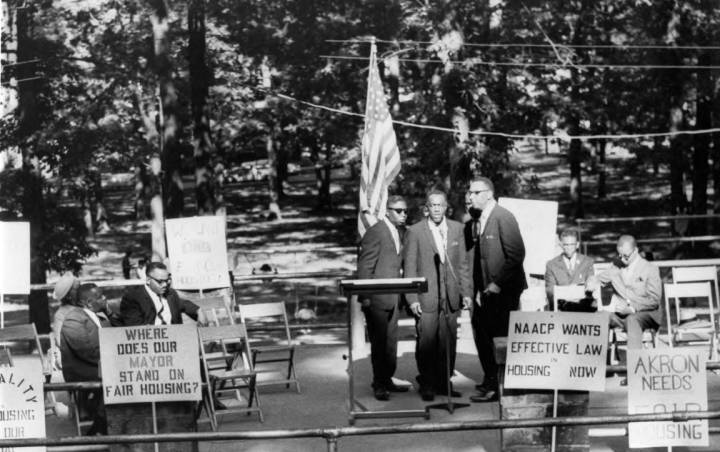
This picture is from 1963 and is a NAACP meeting protesting to have fair housing rights. This picture demonstrates the supreme and fight and will that people had to erase discrimination in every facet of life. Though this not a protest directly referring to education, housing has a direct impact on the type of education that people have access to and can shape a persons whole education as not having a stable home is a severe disadvantage to one’s education.
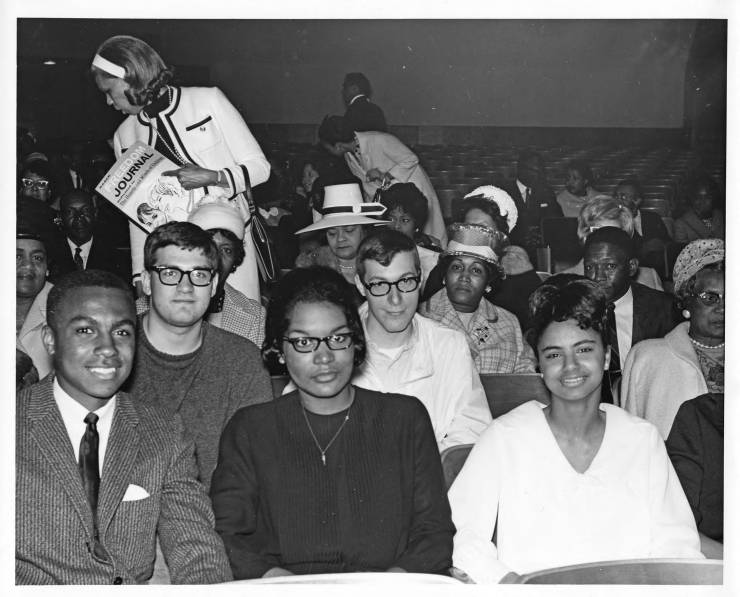
Picture of the NCAAP celebrating the tenth anniversary of the Brown vs. board of education decision. I found this image to be particularly intriguing as it shows that people were celebrating and looking at the case in a favorable manner view. Though the case has its issues with vague language and is not a magical fix to discrimination, the case is still treated in mythical regard and is looked upon as a case that had profound positive impact on discrimination in America.
Conclusion
This blog highlights the complex legacy of the Brown vs board of education case, examining how the law did have positive impacts but also acknowledging the shortcomings of the outcome of the case and how the case did not fix discrimination completely. Additionally though the Brown vs board of education case was focused on education discrimination is still rampant in every fabric of society. This is important as discrimination in other parts of society directly affects the discrimination that occurs within schools. This leads to a viscous cycle that needs to be broken even to this day.
